Free postage on all orders over £95.
Coopers Beer Kits now in stock
View our latest Special Offers
5% Discount on orders over £150.00
£4.50 £4.00
American ale yeast producing well balanced beers with low diacetyl and a very clean, crisp end palate. Forms a firm foam head and presents a very good ability to stay in suspension during fermentation.
Sedimentation: medium
Final Gravity: low to medium
Temperature Range: 15-24ºC
Dosage: 11.5 g in 20 to 30 L
18 in stock
Young’s Bordeux Red Wine Yeast is truly a top quality strain that delivers outstanding home wine making results. Some red wine yeast strains on the market will strip out fruit flavour and colour from the must, however the complete opposite is true of this strain. Your wine will retain the viticulture and natural fruit characteristics of the grape and it’s synonymous claret colouring. This yeast will allow you make wines that are full of the balanced soft fruit flavour and character that is associated with traditional old world Bordeux reds. Expect pronounced dark fruit notes on the nose, as well as some spicy characteristics, well balanced wines with good palate length and intense fruit flavours. This medium foaming yeast has the ability ferment up to 15% ABV and produce truly sublime wines suitable for maturation.
Technical Information
Gluten Free
Alcohol tolerance: 15% v/v
Glycerol production: 6g/L
Foaming: Medium
Low production of volatile acids
Low production of SO
Viability: >1.0 x 10 CFU/g
Rehydration
During yeast manufacture, special processs are employed to promote very high leveles of the natural compound – Trehalose within the yeast.
Trehalose is a natural sugar produced within the yeast cells to protect itself during prolonged storage and stress conditions.
The very high levels of trehalose acheieved also remove the need for re-hydration before adding to must or wort – there is now no advantage in doing this even for high alcohol wines.
Saccharomyces Cerevisiae – Ideally suited for rich, full bodied red wines with exceptional flavour complexity.
Noted for exceptional depth and flavour complexity, R56 exhibits complex aromatics during fermentation conferring an old world quality which one might only expect from natural flora multiple strain fermentations.
Unusually for complex aromatic strains, R56 still respects the varietal character of the fruit and confers good structure and balance. R56 is also a high glycerol producing strain.
R56 is a medium rate fermenter with optimal temperature between 22 to 30ºC (72 -86ºF) which will ferment to 13.5% abv. ethanol.
Saccharomyces Cerevisiae – For sweet white/blush and dessert wines. Produces high levels of desirable congeners during fermentation including aromatic thiols, imparting rich fruity aromatics, full body and ‘tropical’ flavor characteristics. CY17 is also noted for high glycerol formation, further enhancing sweetness.
This is a slow fermenter compared to all other strains in the Mangrove Jack’s range, typically taking up to 21 days to ferment table wines and up to 35 days for dessert wines. CY17 prefers a constant temperature in the 22 – 26ºC (72 -78ºF) range. Dropping the temperature below 15ºC (59ºF) two thirds of the way through fermentation will arrest fermentation making CY17 suitable for producing naturally sweet wines (both potassium sorbate and metabisulphite must be used to prevent re-fermentation).
CY17 is also excellent for sweet sparkling wines, but CL23 must be employed for the bottle fermentation stage.
Avoid free SO2 levels above 50 ppm and ensure pH above 3.2, CY17 is a delicate strain that must be treated with some respect. Pay particular attention to sterile winemaking conditions and a warm start to fermentation otherwise risk of bacterial contamination is increased. CY17 will happily ferment up to 15% abv. ethanol if such conditions are employed
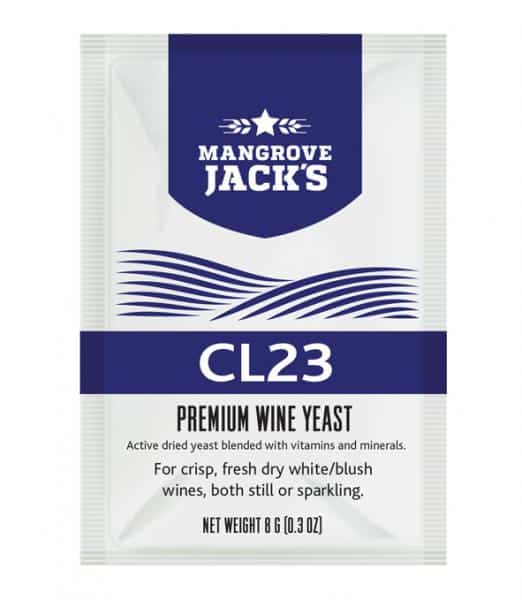
Ideal for crisp, fresh dry white/blush and all sparkling wines. Also the best strain for high alcohol tolerance. CL23 produces very low levels of fusel oils and other congener compounds during fermentation and so does not contribute much to wine flavour or aroma and can therefore be considered to be a particularly neutral / clean fermenter.
However CL23 does contribute significantly to the wines structure and ferments out sugars completely allowing for the driest of wines to be made. CL23 is noted for its robustness, being able to ferment to 18% ABV. Ethanol, tolerate high free SO2 and high levels of other stress factors such as organic acids, incorrect temperature and pH making CL23 the strain of choice for high alcohol wines or where uncertain recipes are employed and fermentation reliability is a key factor or where low temperature fermentation down to 80ºC (46ºF) is required.